Hakone Day Trip From Tokyo: Complete One-Day Guide
How to plan a Hakone day trip from Tokyo, from the Romancecar and the ropeway over Owakudani to the Lake Ashi cruise, Hakone Shrine, the Freepass and when a tour is easier.
Hakone is one of the easiest ways to leave Tokyo for a day without spending half of it on trains. In one trip you can ride a mountain railway, cross volcanic ground by ropeway, look into the steaming valley of Owakudani, cruise across Lake Ashi and visit Hakone Shrine on the lakeshore, then be back in Tokyo for dinner. On a clear day, Mount Fuji appears above the surrounding mountains. Hakone easily fills a day; the harder part is deciding how much to fit in.
Check Availability
Tokyo: Mt. Fuji Tour, Hakone Ropeway, Owakudani, Lake Ashi — A shared Tokyo day trip linking Hakone Shrine, the ropeway and Owakudani with Lake Yamanaka and Oshino Hakkai. Cruise fare is extra.
Is Hakone Worth a Day Trip From Tokyo?
Yes, particularly if you want something very different from another day of sightseeing in Tokyo.
Hakone works well as a day trip because several of its headline attractions sit on one natural sightseeing circuit. A typical day can include:
- Hakone-Yumoto
- Hakone Tozan mountain transport
- the Hakone Ropeway
- Owakudani volcanic valley
- Lake Ashi
- the Hakone sightseeing cruise
- Hakone Shrine
- views of Mount Fuji when the weather cooperates
Hakone is also close enough to Tokyo that you don’t need to stay overnight to see its main sights. The direct Romancecar from Shinjuku to Hakone-Yumoto takes about 80 minutes, so an early start from Tokyo puts you in the mountains by mid-morning.
The main drawback is that Hakone is not one single attraction. You move between trains, cable cars, a ropeway, boats and buses during the day. That is part of the fun, but it also means a badly planned day can turn rushed.
The Best Hakone Day Trip Itinerary
For a first visit, the classic Hakone sightseeing loop is hard to beat. A practical route is:
Tokyo → Hakone-Yumoto → Gora → Sounzan → Owakudani → Togendai → Lake Ashi → Moto-Hakone → Hakone Shrine → Tokyo
This follows the same general direction as the official Hakone one-day sightseeing route. The timings below give you the outline; our one-day Hakone itinerary walks the same loop stop by stop, and the Hakone day trip itinerary covers the guided version.
7:30–9:00 — Tokyo to Hakone
If you’re staying in Shinjuku, the simplest option is the Odakyu Limited Express Romancecar. It runs directly from Shinjuku to Hakone-Yumoto with no transfer, and every seat is reserved, so the day starts far more calmly than it would on several local trains. The limited-express surcharge is ¥1,200 for adults and ¥600 for children on top of the regular fare.
Try to leave Tokyo early. Hakone is much easier when you arrive around 9:00 than closer to lunchtime.
9:00–10:30 — Hakone-Yumoto and the Mountain Route
Hakone-Yumoto is the main gateway to Hakone. From here, continue deeper into the mountains toward Gora.
The transport is part of the day out. The route climbs through steep, forested terrain on the way from one attraction to the next.
If you want to add the Hakone Open-Air Museum, this is the logical part of the day to do it. On a one-day trip, though, I would make a choice: the museum or a relaxed classic Hakone loop. Trying to do everything can leave too little time around Lake Ashi and Hakone Shrine later in the afternoon.
Hakone Ropeway
From Gora, continue by cable car to Sounzan and transfer to the Hakone Ropeway. The ride is one of the highlights of the trip in its own right.
The gondolas cross the mountains toward Owakudani, with views over the volcanic landscape and, in suitable weather, Mount Fuji. The Sounzan to Owakudani section takes about 15 minutes.
The ropeway operator runs from 9:00 to 17:00 between February and November and from 9:00 to 16:15 in December and January. Weather, inspections or maintenance can suspend service, so check the operating status before you leave Tokyo. Our Hakone Ropeway guide covers tickets, closures and which direction to ride.
Owakudani
Get off the ropeway at Owakudani instead of riding straight through.
This volcanic valley is still geothermally active. Steam rises from the mountainside, and the landscape looks nothing like Tokyo or the forested sections of Hakone you have just traveled through.
Owakudani is also one of the places where you may get an excellent view of Mount Fuji. Don’t plan the whole trip around that view, though. Fuji visibility depends heavily on cloud, and the mountain can disappear completely even when the rest of Hakone has perfectly good sightseeing weather. Treat the Fuji view as a bonus. Our Owakudani guide covers the black eggs, how long to stay and what happens when access is restricted.
Owakudani to Lake Ashi
Continue on the ropeway from Owakudani toward Togendai. The landscape changes again as you descend toward Lake Ashi.
Togendai sits on the northern shore of the lake and is one of the boarding points for Hakone’s sightseeing cruises.
Lake Ashi Cruise
The sightseeing boat across Lake Ashi is another attraction that doubles as transport. Instead of going back the way you came, you cross the lake toward Hakone-machi or Moto-Hakone.
On clear days, this crossing gives you another chance to see Mount Fuji beyond the lake. The ships are often called Hakone’s pirate ships because of their elaborate European-style design.
For a first-time visitor, include the cruise. It links two important parts of the loop and shows you Hakone from the water. Our Lake Ashi guide covers the piers and where to get off, and the pirate ship cruise review weighs the ride itself. If you would like the cruise ticket bundled into a guided day, the H.I.S. Fuji and Hakone tour with a bullet-train return (from $115 per person) includes both the ropeway and the Lake Ashi cruise.
Hakone Shrine
Get off around Moto-Hakone for Hakone Shrine.
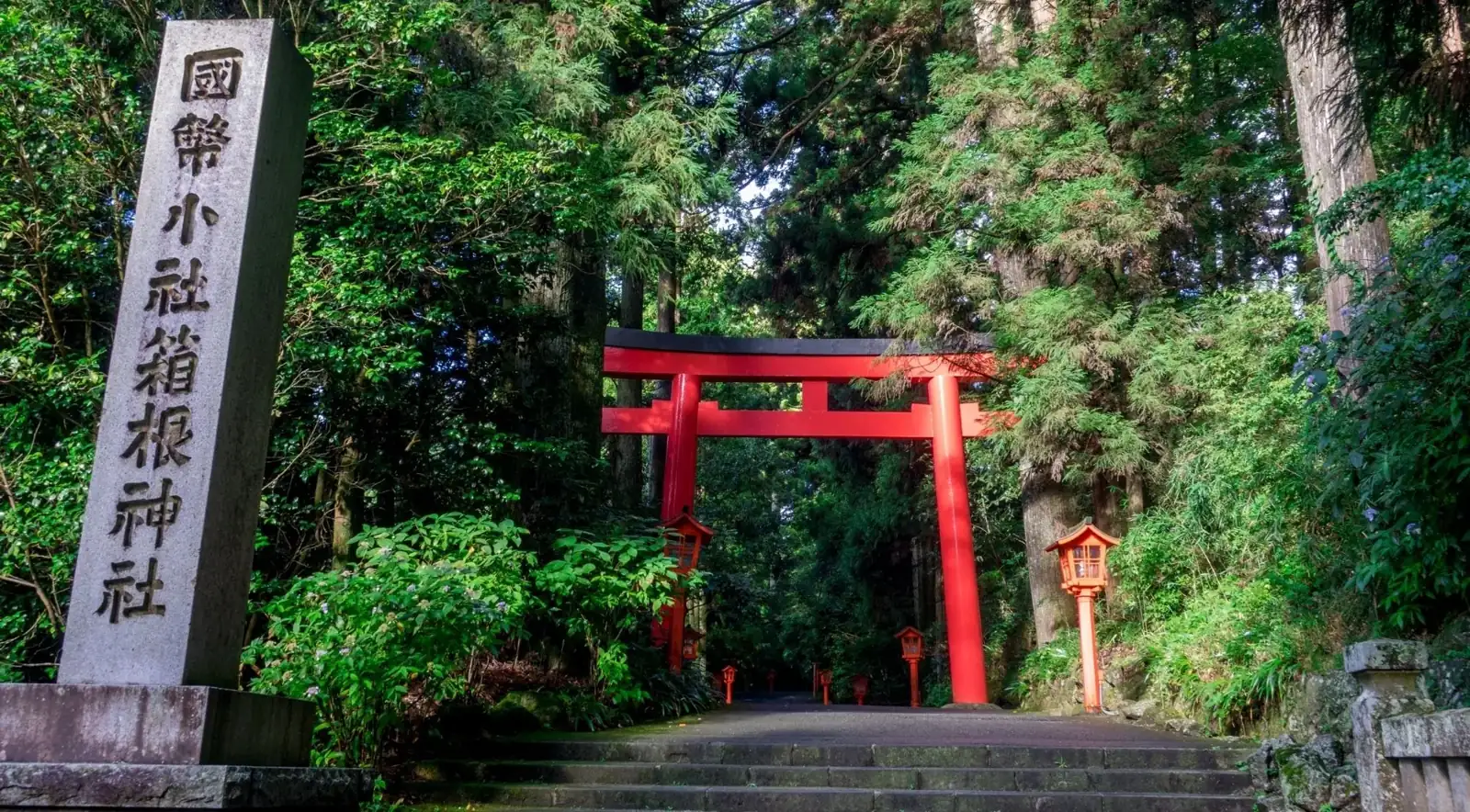
The shrine stands in forest beside Lake Ashi and has more than 1,200 years of history. Its best-known feature is the red Torii Gate of Peace, which stands in the water at the edge of the lake. It is one of Hakone’s most photographed spots.
There can be a queue for the classic photograph beneath the torii, particularly on busy days. If time is getting tight, don’t let one photograph decide the rest of your day. The shrine grounds and lakeside setting are lovely even without it. Our Hakone Shrine guide has the details.
Returning to Tokyo
From Moto-Hakone, buses run back toward Hakone-Yumoto. Traffic can cause delays later in the day, so avoid planning your return down to the minute.
From Hakone-Yumoto you can return to Shinjuku.
Tokyo to Hakone: What’s the Best Way?
For most first-time visitors there are three realistic approaches. Our Tokyo to Hakone transport guide compares them in more detail.
Romancecar from Shinjuku
Best for: convenience
The Romancecar runs directly between Shinjuku and Hakone-Yumoto in about 80 minutes. There is no transfer and seats are reserved.
Train via Odawara
Best for: travelers coming from Tokyo Station or using JR transport
You can travel to Odawara first and continue into Hakone from there.
Guided day tour from Tokyo
Best for: seeing a lot without organizing Hakone’s transport yourself
A guided tour suits you best if your main goal is seeing Hakone and Mount Fuji in the same day. The TAIHOU shared sightseeing tour (from $54 per person, 4.6/5 from more than 8,000 reviews) includes a one-way ropeway ride over Owakudani, Lake Ashi and Hakone Shrine. The Clover Travel day trip (from $49 per person, 4.9/5 from more than 1,100 reviews) runs a similar Hakone route and adds Fuji-area stops. Our Hakone tour chooser compares them with the private options.
Is the Hakone Freepass Worth It for One Day?
The Hakone Freepass is sold as a 2-day or 3-day pass, but it can still make sense for a long day trip because it covers a large share of the transport inside Hakone.
The pass includes transport across the Hakone area and discounts at participating attractions. The Romancecar needs an additional limited-express ticket.
If you follow the full loop, the convenience can matter as much as the saving. Our Hakone Freepass guide runs the numbers.
Can You See Mount Fuji From Hakone?
Yes, but never treat a Mount Fuji sighting as guaranteed.
Some of the best chances are around:
- the Hakone Ropeway
- Owakudani
- Lake Ashi
- the northern part of the lake around Togendai
If seeing Mount Fuji matters more to you than Hakone itself, consider a day in the Fuji Five Lakes area around Kawaguchiko instead.
Hakone vs Mount Fuji Day Trip
Choose Hakone if you want:
- varied scenery
- Lake Ashi
- hot springs
- Owakudani
- Hakone Shrine
- ropeways and mountain transport
- a day that stays interesting even if Fuji is hidden
Choose a Mount Fuji-focused day trip if your main aim is getting close to Fuji and visiting places known specifically for Fuji views.
There is also a third option: take a combined Mount Fuji and Hakone tour. The Clover Travel day trip above continues from Hakone to Lake Yamanaka and Oshino Hakkai, closer to the mountain.
Hakone Independently or With a Tour?
You can easily do Hakone without a tour.
Go independently if you want control over your time, enjoy scenic public transport or want to add an onsen. Consider a guided tour if you want to combine Hakone and Mount Fuji or would prefer not to handle several transport connections.
For a straightforward Hakone-only day, independent travel works very well. For Mount Fuji and Hakone in one day, a tour usually makes much more sense. Our tour versus self-guided comparison sets out what you gain and give up with each.
Can You Visit an Onsen on a Hakone Day Trip?
Yes. Some facilities accept daytime visitors.
Adding an onsen changes the day, though. Doing the whole loop, spending real time in a hot spring and getting back to Tokyo in the evening can leave you rushed.
If hot springs are a priority, consider cutting one of the major sightseeing stops. If you would rather someone else plans the bathing stop, the HavenJapan private onsen, art and nature tour (from $317 per person, 4.9/5 from 148 reviews) lets you build the day around a hot spring or a museum; our Hakone onsen day trip page has the details.
How Much Time Do You Need in Hakone?
For a day trip, allow a full day.
Leaving Tokyo around 7:00–8:00 a.m. and returning in the evening gives you enough time for the classic loop without constantly watching the clock.
A half-day visit is possible, but it misses much of what makes Hakone special.
What Should You Prioritize if You Only Have One Day?
For a first Hakone day trip, prioritize:
- Hakone Ropeway
- Owakudani
- Lake Ashi cruise
- Hakone Shrine
- Mount Fuji views whenever the weather allows
Add the Open-Air Museum if art is especially important to you. Add an onsen if the hot spring matters more to you than completing the whole loop. For more ideas, see our list of the best things to do in Hakone on a day trip, and if you are traveling with children, our Hakone day trip with kids guide.
Is a Hakone Day Trip From Tokyo Worth It?
For most first-time visitors, yes.
Tokyo gives you temples, neighborhoods, skyscrapers, food and nonstop city energy. Hakone gives you something different within day-trip distance: volcanic mountains, forest, hot springs, a lake and one of Japan’s most famous views.
Take the train into the mountains. Ride the ropeway over Owakudani. Cross Lake Ashi by boat. Walk through the forest to Hakone Shrine. Then return to Tokyo.
If you have one free day and want to see Japan beyond the capital, Hakone is one of the best day trips you can make from Tokyo. Check the ropeway and cruise status the evening before, because weather can change the route.
Make a Day for Hakone
Choose your departure point, check the inclusions and leave your evening flexible for the journey back.
Check Dates & Prices